Plenty of companies reach a point where they need senior technology judgment but don't need, or can't yet justify, a full-time executive leader. Fractional and advisory leadership fills that gap.
How it works
A fractional advisor is an experienced technology leader who works with you part time. Depending on what the business needs, they can lead, advise, or do some of each, and the mix can change as the company does.
They work alongside whatever leadership you already have. That might mean stepping in as your senior technology leader and partnering with a COO or CFO who oversees IT. CIOs and CTOs bring them in too, for example when they need an infrastructure and operations expert without adding a full-time role.
Whatever the setup, you get senior experience for the share of time the work actually needs. Here are three situations where it makes the biggest difference.
Your company is growing faster than its IT foundation
A fast-growing company needs senior IT expertise, but not a full-time executive. So it does the sensible thing and hires a capable mid-level engineer to set up Microsoft 365 or build an environment in AWS or Azure. The work gets done, and for a while everything looks fine.
What doesn't get built is the foundation underneath, like how access gets granted and removed, or who keeps an eye on cloud spending. Someone at that level is focused on getting systems running, and usually hasn't seen enough growth to know why governance and strategy come first.
That's not a knock on them. It's leadership work, and it was never in the job description.
Then time goes by, and the missing foundation turns into technical debt. Sometimes the bill is an expensive overhaul. Sometimes it's money quietly leaking out through licenses still assigned to people who left and cloud resources nobody remembers creating.
The worst version is a security risk nobody knows about until something goes wrong.
Bringing in fractional and advisory help early gives you a roadmap before the foundation sets. Your mid-level team gets guidance from someone who has seen where the shortcuts lead. They still do the hands-on work, just inside a plan.
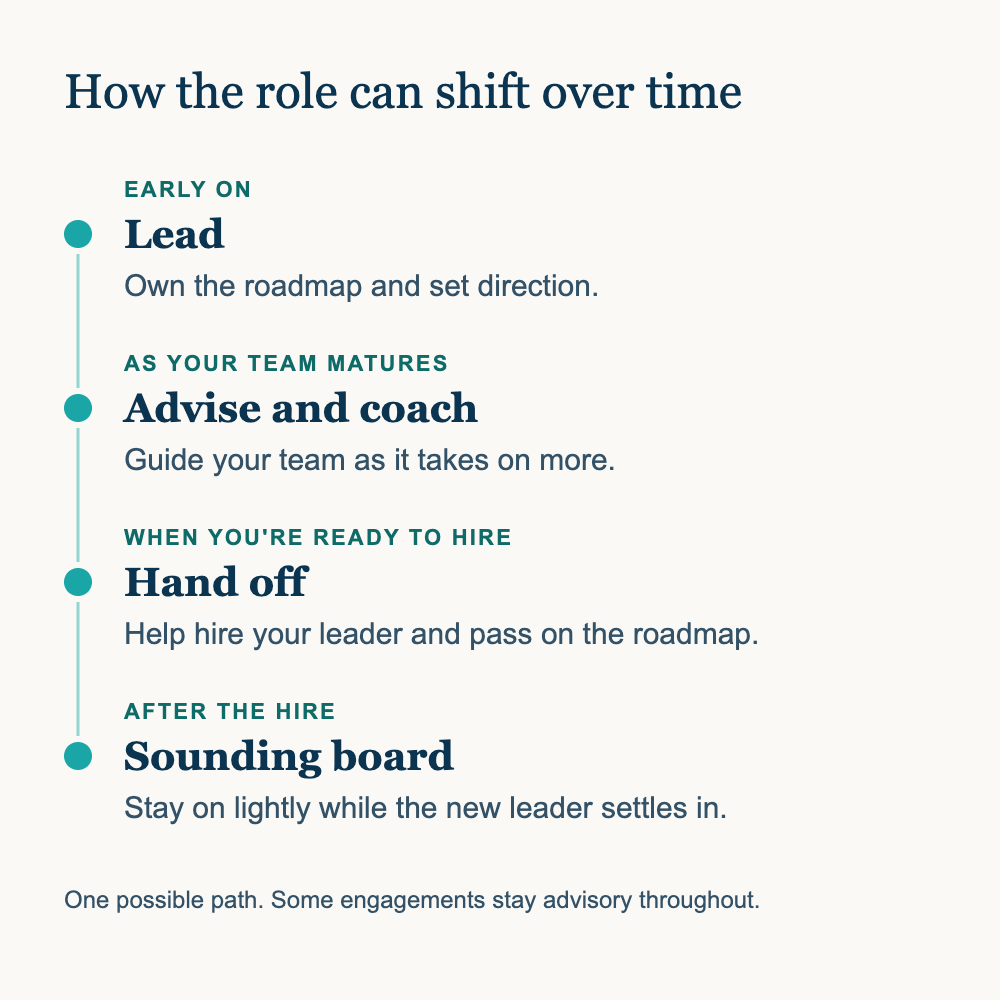
Early on, that may mean your fractional advisor owns the roadmap outright. As your team matures, the role can shift toward advising and coaching.
You lose a key IT leader
When a key IT leader leaves, the roadmap they were driving tends to stall. Their direct reports may be strong, but they lack the experience to own strategy or the time to take it on. Often it's both.
Meanwhile, the decisions keep coming. Contracts still come up for renewal, and projects still need someone to make the call. Finding the right replacement can take months.
A fractional advisor can step in to own the roadmap and keep it moving while you hire. Along the way, they guide the direct reports who are absorbing the extra work.
That coverage also buys time for a question that's easy to skip in a scramble. Do you need the same role back, or a different one?
You need expertise your team doesn't have
Sometimes the gap isn't leadership at all. You have a capable IT leader and team, and you recognize that a specific area sits outside their experience.
It might be an AI strategy or a major Microsoft licensing renewal. In life sciences, it's often advice on systems that have to stand up to scrutiny from a regulatory authority.
Recognizing that gap is good leadership. The alternative is learning on the job with a decision that's costly to get wrong. Vendors can help, but their job is to deliver their own piece, not to judge how it fits the bigger picture.
A fractional advisor lets your leader keep ownership of the decision while drawing on someone who has made it before.
Before you start
Most engagements succeed or fail on what gets settled at the outset. Name an executive sponsor. Agree on the time commitment and what you expect to have at the end.
Be explicit about which decisions your fractional advisor makes and which stay with your team, and make sure someone owns carrying them out. Advice nobody acts on is money wasted.
Planning the move to a full-time leader
For a lot of companies, a fractional advisor is the right answer for a stage of growth. When the work grows into a full-time job, that's a sign the engagement did what it was supposed to.
The smoothest transitions are planned from the start. Your advisor knows your environment and roadmap, so they're well placed to help define the full-time role and evaluate candidates.
Your new leader should inherit a roadmap that's already moving and a record of what was decided and why. Consider keeping your advisor on for a few months afterward, in a lighter role. That gives the new leader a sounding board while they settle in.
The common thread
Expensive technology problems rarely start with a bad hire or a bad product. More often, someone made a reasonable call without the experience to see where it would lead. That's the case for bringing senior judgment in early, even part time.